

Kessler Pongamia Biochar - a solution for decarbonizing the steel industry
The steel industry is one of the most energy-intensive industrial sectors and is responsible for a significant portion of global greenhouse gas emissions.
Direct emissions from iron and steel production are about 2.6 gigatonnes (billion tons) per year. Steel production accounts for about 7-9% of total global fossil fuel emissions.
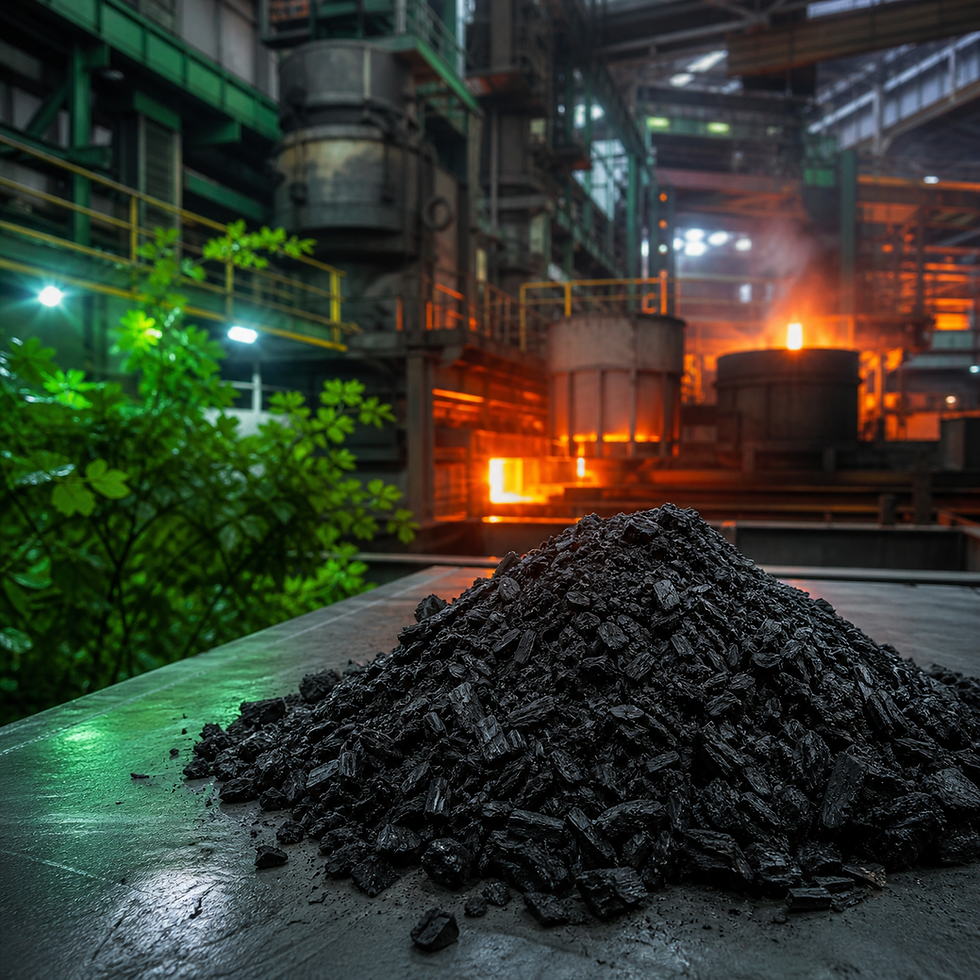
Biochar is playing an increasingly important role in the production of so-called green steel, slowly becoming a renewable, ecological replacement for fossil fuels that will allow a drastic, effective reduction in carbon dioxide emissions in the steel industry.
The use of biochar in green steel production is a key solution to decarbonizing the steel industry, replacing fossil carbon with a renewable source. Biochar, produced by pyrolysis of biomass, is an emissions-neutral reductant that drastically and effectively reduces the carbon footprint of steelmaking processes.
For biochar production from Pongamia, the best raw material is Pongamia shells
Pongamia shells constitute about 50% of the dry fruit weight, which makes them a very large and cheap source of biomass, characterized by a very favorable lignocellulosic structure, and this has a direct impact on the qualitative stability of biochar and high organic carbon content.
Since Pongamia shells are classified as a waste raw material (forest waste), they are among the most profitable raw materials for biochar production, and their use in the production process results in the lowest costs per ton of CO2 removed.
Ash content as a key quality parameter in the Biochar production process
The ash content of the raw material is crucial for the quality, yield, and final price of biochar. In the case of Pongamia, this is a critical parameter, as it determines whether the product will be used for agriculture or industry. The more ash in the raw material (minerals), the less pure organic carbon the biochar contains.
During pyrolysis, the mass of the raw material decreases, while all the ash remains. If the raw material has 5% ash, the finished biochar may have 15–20%. Pongamia shells typically have a moderate ash content (approx. 2-5%), which is closely related to the diversity of genetic varieties of this tree. For comparison, rice straw has approximately 15-20%, tree bark 2-4%, cereal straw 3-4%, rapeseed straw 4-5%, typical biomass from energy crops 2-6%, bagasse 2-5%, sunflower straw - 5%.
The quality of the raw material from our genetic variety 5781-A
KESSLER elite genetic variety Pongamia 5781-A is one of our primary genetic varieties of this tree, designed for cultivation in desert and degraded areas. This variety has been developed exclusively by KESSLER and the Ministry of Agriculture of the State of Israel, and thoroughly tested by specialists from the Israeli ARO Institute. The presence of ash in the Pongamia shells was carefully examined and confirmed at every stage of fruit development. This value was confirmed at 0.6%.
Pongamia shells from the 5781-A genetics, with an ash content of 0.6% (dry weight), are a premium material. This exceptionally low value enables the production of biochar with the highest quality and purity.
The ash content of the finished biochar will be approximately 2–3%.
This also means that the product (biochar) from this genetic variety will contain more than 85–90% pure organic carbon.
Our product meets the most stringent European Biochar Certificate (EBC) standards for the "Premium" or "Feed" class (feed additive). Such biochar is very stable over time (with high H/C and O/C ratios), which guarantees the highest possible price for carbon credits.
#Pongamia #Biochar #GreenSteel #SteelDecarbonization #CarbonRemoval #CarbonCredits #Renewable #Biomass #Pyrolysis #LowCarbonSteel #Decarbonization #SustainableBiomass #PongamiaShells #EuropeanBiocharCertificate


תגובות