

Why KESSLER Pongamia Carbon Credits Stand Out
At KESSLER, we often discuss our Pongamia Smart Carbon Plantation (SCP) model in the context of advanced renewable fuels and energy feedstocks.
But energy is only one part of the story.
Today, we would like to focus on another important product of the project: Carbon Credits.
The value of a carbon credit is not determined by one factor alone. Pricing depends on the type of market (regulated or voluntary), the quality of the project, the verification standard, permanence, additional environmental and social benefits, and, of course, the relationship between supply and demand.
Some of the main factors influencing the price of Carbon Credits include:
• Project type – Removing carbon directly from the atmosphere, for example through reforestation and the creation of new green areas, is generally more valuable than conventional industrial emission avoidance.
• Project sustainability and permanence – The length of time carbon remains captured and sequestered is critical. Projects capable of storing carbon for many decades are more valuable than projects with a higher risk of future re-release.
• Certification standard – Certification and verification under recognized standards such as Gold Standard or Verra are important components of project credibility and market value.
• Co-benefits – Projects that create measurable additional benefits for local communities, biodiversity, soil, water resources and ecosystems can command significantly greater interest.
So, what does this mean for our Pongamia SCP project in Kenya?
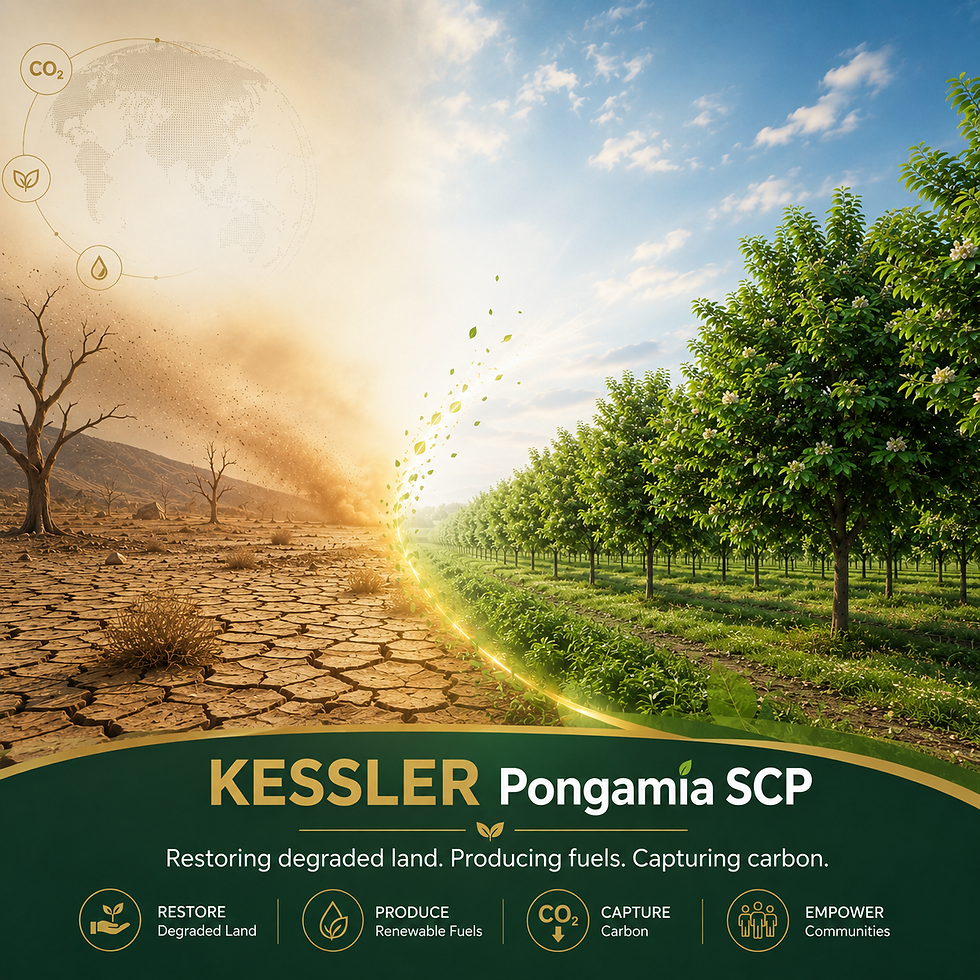
Our elite Pongamia plantations are designed to create new forest areas using elite genetic varieties of Pongamia, specifically developed for degraded and desert environments and soils.
Carbon credits generated from ARR – Afforestation, Reforestation, and Revegetation – projects are highly valuable because they not only avoid emissions but also sequester carbon. They actively remove CO₂ from the atmosphere while generating additional environmental benefits.
Such plantations can contribute to biodiversity and the protection of local water resources, and support local communities. An important characteristic of the KESSLER model is that we use only the fruit of the trees. The trees themselves continue to live for decades.
This means that carbon accumulated in the tree biomass and root system can remain stored for more than 80 years.
What is especially important?
The KESSLER Pongamia SCP proved concept goes beyond conventional afforestation.
Our model combines:
Afforestation
Forest restoration
Greening of degraded land
Regenerative agriculture
Natural land reclamation
—> all based on the characteristics of our elite Pongamia genetic varieties.
Combining these processes within one Smart Carbon Plantation model means that our project in the Republic of Kenya already enters the field of what are often described as Hybrid Projects, including Agroforestry and ALM – Agricultural Land Management.
This can significantly increase the potential value of the Carbon Credits generated by the plantation.
In KESSLER Pongamia SCP model, we have TWO carbon stores.
Carbon is captured not only in the growing trees and their root systems.
It is also captured directly in the soil as Soil Organic Carbon – SOC.
Transforming completely degraded land into a living, productive ecosystem can therefore create an additional layer of carbon sequestration while substantially improving the land's environmental quality.
Another major advantage is the absence of land-use conflict.
KESSSLER Pongamia plantations are designed specifically for degraded land. They do not need to replace productive agricultural land. Instead, they help transform degraded areas into productive landscapes, enable food production and regenerative agriculture, restore ecosystems, and contribute to climate protection.
Why KESSLER Pongamia plantations stand out as one of the most powerful climate and land-restoration solutions available today
• Extreme climate resilience: Our elite Pongamia varieties are designed for desert and degraded environments and demonstrate very high resistance to extreme climatic conditions. This significantly reduces the risk of plantation loss during drought or flooding, thereby reducing the risk of losing the carbon stored by the project.
• Natural soil nitrogen fixation – Our elite Pongamia genetic varieties naturally fix nitrogen from the atmosphere and introduce it into the soil. This reduces the need for artificial nitrogen fertilizers, which themselves generate significant emissions.
• No logging risk: Only the fruit is harvested. The trees remain in place for more than 80 years, continuing to store carbon in their biomass and root systems throughout this period.
• Powerful co-benefits: Implementation of KESSLER’s and ARO’s proven Pongamia SCP model supports regenerative agriculture, food production on degraded land, transformation of damaged land into rich ecosystems, and the creation of biological corridors for animals.
Summary
Carbon credits generated by the KESSLER Pongamia project in the Republic of Kenya combine several important elements:
Pongamia reforestation
Land reclamation
Regenerative agriculture
Long-term biomass carbon storage
Soil Organic Carbon
Biodiversity restoration
Community and agricultural co-benefits
For these reasons, these credits are positioned at the high end of the carbon market and within the category increasingly described as High-Integrity Carbon Removal.
This is particularly important for institutional investors and large corporations that are becoming increasingly selective about the quality, permanence, and verifiability of the carbon credits they purchase, and that want to minimize the reputational risk associated with greenwashing.
And finally, perhaps the most important point:
Our Pongamia SCP model is not only theoretical.
It is already operational and has been fully validated and confirmed by the Israeli Ministry of Agriculture at our plantation in the Negev Desert.
The model is working. The trees are growing fast and are the most fruitful, and the desert is becoming a green garden. The development of the plantations and facilities on approximately 50,000 hectares in the Republic of Kenya is an important milestone for KESSLER, for the development of advanced renewable fuels and high-integrity carbon removal, and for the Israeli ARO Institute, which has been a co-creator of our joint success.
For us, the objective is clear:
Produce advanced renewable energy resources. Restore degraded land. Capture carbon for decades. Build productive ecosystems where there is almost nothing today.
#CarbonCredits #CarbonRemoval #Pongamia #Agroforestry #RegenerativeAgriculture #ClimateTech #RenewableFuels #SAF #HVO #Biofuels #SoilCarbon #Reforestation #Kenya #Israel #KESSLER #AridAgriculture
\


תגובות